UCLA Global Medical BrigadesJunior ScienceCompetition 2027
For Grades K-5 Students
Teacher or school coordinator? Email [email protected] to create your School Dashboard. Manage, monitor & analyze student communications, results and awards.
.png)
Step into:
This challenge is for you if you:
- Are developing interest in STEM
- Show curiosity about how the world works
- Benefit from structured, engaging challenges
Summary
Online test with multiple choice and fill-in the blank questions
Poster/pitch deck to present a science solution
Present science solution live on zoom
2-5 students from the same school
Lower Primary (Grades K-2), Upper Primary (Grades 3-5)
Option to join World STEM League Program

About UCLA Global Medical Brigades
Global Medical Brigades is a non-profit that partners with rural communities around the world, and works with them to provide free medical and dental care and improve their access to healthcare year-round.
The UCLA Global Medical Brigades chapter is a student run organization that participates in week long medical brigades to staff pop up clinics in countries like Honduras, Guatemala, Panama, and Ghana and provide continued access to healthcare to the citizens of these communities. Our team is a diverse group of pre-health and public health students that work together to bridge access gaps and create a better, healthier world, one community at a time.
About the World STEM League Program
UCLA Global Medical Brigades Junior Science Competition is part of the World STEM League Program. In the League, students compete across multiple competitions throughout the League Year, allowing them to:
Practice repeatedly
Track their improvement over time
Collaborate with teammates across competitions
This creates a cycle of growth: compete, learn, refine, and improve.

Fostering Curiosity and Real-World STEM Learning
UCLA Global Medical Brigades Junior Science Competition is designed as an enriching introduction to STEM that nurtures curiosity, reinforces classroom learning, and encourages students to think beyond the textbook.
The experience begins with a grade-level-appropriate online challenge aligned with core math and science concepts. Students then engage in developing solutions to real-world problems through drawing, building, and creative thinking, before sharing their ideas through a poster for the lower primary category and a simple pitch deck for the upper primary category.
Each stage is intentionally structured to build confidence, develop problem-solving skills, and foster interest and curiosity in STEM.

Why Join UCLA Global Medical Brigades Junior Science Competition?

Encourage curiosity and develop comfort with problem-solving

Deepen understanding by applying classroom knowledge

Explore real-world challenges in an age-appropriate way
How Does the Challenge Work?

Team Size
Team Size: 2-5 students per team (all team members must be from the same school)
Can't find teammates at your school?
Email [email protected] to apply for an exception to create multi-school teams.
Age Categories
(Grades K–2)
(Grades 3–5)
Competition Format
Preliminary Round: Online Challenge
The preliminary round is open to all registered teams worldwide
Asia Pacific: 12:00 noon Tokyo Time
Europe, Middle East, Africa: 9:00 am London Time
North America, South America: 11:00 am New York Time
Lower Primary School Category: 45 minutes
Upper Primary School Category: 1 hour
Read the Test Instructions Before Test Day
Review the test schedule, technology and proctoring requirements, format and scoring, and academic integrity rules.
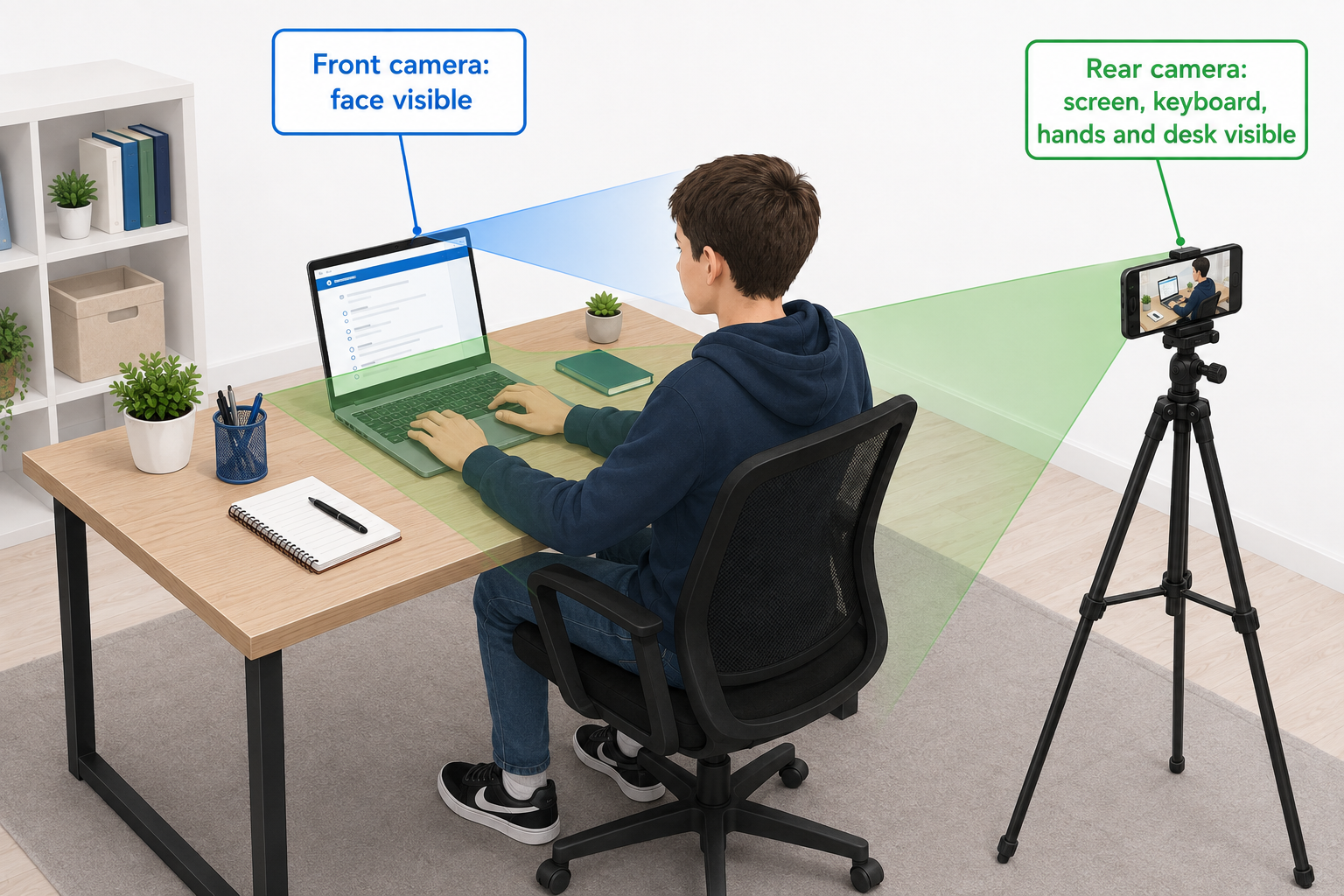
Two-camera proctoring
Prefer not to be recorded? See this article to apply for in-person teacher proctoring.
Before you start
- Check your registered time zone
- Log in at least 10 minutes early and watch the required instructional video
- Enable pop-ups in your browser
Technology requirements
- Use a laptop or desktop with a camera to take the test
- Keep a second camera (phone, tablet or any device with internet access) on throughout the test.
- A stable internet connection
Online challenge (multiple choice, fill in the blanks, and free-response questions)
Each team member will individually attempt the same set of challenges. The top two scores will be used to calculate the team’s total score
A teacher or parent may provide technical support (e.g., platform access, response submission), but all answers must reflect the student's own work.
Students who prefer not to work online may download and print the paper, then upload their answers before the test ends.
Test Questions Formats:
The preliminary round of each STEM competition will use one of two test formats:
Prompt-Based / Applied: Questions will be based on and directly related to the real-world challenge prompts provided in the competition’s prompt package. Students will be expected to apply their knowledge to the given scenarios.
Textbook-Style / Theoretical: Questions will follow a more traditional format and will test students’ understanding of concepts, theories, and material typically covered in textbooks or coursework.
The two formats will alternate from one STEM competition to the next. For example:
1st STEM Competition (Caltech EWB): Prompt-Based
2nd STEM Competition (Rutgers EWB): Textbook-Style
3rd STEM Competition (UC Irvine EWB): Prompt-Based
...
The preliminary-round questions for the UCLA Global Medical Brigades Junior Science Competition are textbook-style.
Focuses on number awareness and foundational math concepts, along with simple logic questions that develop early reasoning skills.
Scope:
Math: Counting and place value to 1000; addition and subtraction within 100; word problems with unknowns in any position; skip counting; odd and even numbers; measurement of length, weight, time, and money; naming, describing, comparing, partitioning, and composing 2-D and 3-D shapes.
Science: Pushes, pulls, and motion; basic needs of plants and animals; weather patterns; light and sound; structure and function of organism parts; inheritance of traits; sun, moon, and star patterns; properties of matter; plant-animal interdependence; landforms and water.
Based on math and science concepts students are learning in school, combined with logic problems that build confidence and problem-solving skills.
Scope:
Math: Multiplication/division fluency and multi-digit arithmetic; factors, multiples, primes; fraction and decimal operations through thousandths; numeric expressions, patterns, and word problems with an unknown; area, perimeter, volume, unit conversion, angle measurement; shape classification by properties.
Science: Balanced/unbalanced forces; electric and magnetic interactions; animal behavior and inherited traits; life cycles; weather vs. climate and hazards; energy transfer; wave and light properties; organism structures; rock formation and erosion; states and changes of matter; food webs and matter cycling; Earth's water; sun, moon, and gravity.
Semi-Final Round: Poster / Pitch Deck
The top 10 performing teams from the preliminary round in each of the Lower Primary and Upper Primary Categories will be invited to compete in the global semi-final round
Lower Primary School Category (Grades K–2): Semi-finalist teams will have one week to create a poster with a solution to a science problem.
Upper Primary School Category (Grades 3–5): Semi-finalist teams will have one week to develop a solution to a science problem and present their work through a pitch deck.
Final Round: Live Zoom Presentation
The top 5 performing teams from the semi-final round in each of the Lower Primary and Upper Primary Categories will be invited to compete in the global final round
Finalist teams will have one week to refine and improve their solutions from the semi-final round based on judges’ feedback, and present their final solution to a judging panel composed of UCLA student healthcare practitioners.
Key Dates and Deadlines


Registration Deadlines and Participation Fees

Deadline: October 22, 2026
Fees: US$ 45/student

Deadline: February 22, 2027
Fees: US$ 55/student

Deadline: April 22, 2027
Fees: US$ 65/student

Recognition
All participants will receive a Certificate for participation


Preliminary Round
 Honor
Honor Merit
MeritSemi- Final Round
 Semi Finalist
 Individual Category
Top participants will receive individual honors, even if their teams may not win any awards.

 Team category
Teams will be awarded based on the sum of their two highest individual scores.


Final Round
 Global Champion
 Global 1st Runner Up
 Global 2nd Runner Up
 Finalist
Join the Challenge
This competition is more than a contest; it’s a gateway to the world of STEM innovation. Register now to begin your journey into STEM, where you’ll apply creative problem-solving and technical skills to real-world challenges.
Fee Waiver Policy
Fee waiver is available for individual low-income students. Please ask your principal (or school counsellor - only eligible for US schools) to send an email titled 'Fee Waiver Request' to [email protected] from their official school email with your email address and confirm you need a waiver.
US public schools where 90%+ of students qualify for free or reduced-price lunch may also apply for school-wide waivers for all competitions with a quiz-based first round.
All fee waivers must be requested before the regular deadline. For the exact eligibility rules on fee waivers please refer to this article.

AlgoEd is a platform that hosts curated competitions for K-12 students.
Explore Competitions